10x faster multi-ECU regression testing in SIL
Measured impact at a European vehicle OEM: Complementing HIL with virtual integration testing to offer a faster and more accessible alternative for regression testing. The outcome? 10x increased feedback speed for end to end integration tests, less dependency on HIL, and the ability for developers to run near-hardware realism tests involving multiple ECUs directly on their own laptops.
How to complement multi-ECU HIL tests with SIL
In modern vehicle systems, even simple actions like personalization settings on the infotainment screen trigger communication across multiple ECUs. Validating a change like this in hardware means booking a HIL rig with every relevant ECU available and correctly flashed.
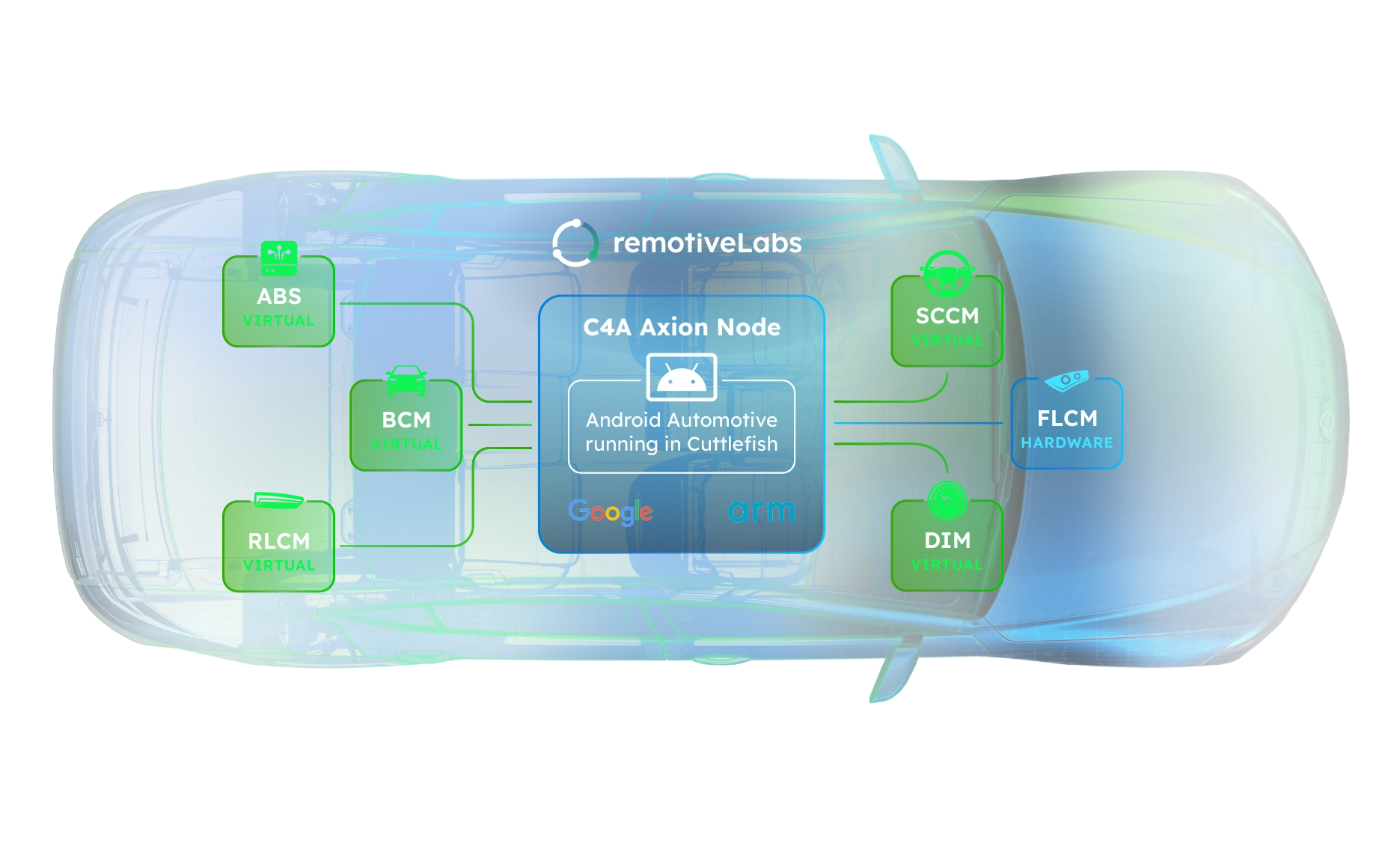
This case study focuses on measurable results from complementing hardware testing with virtual integration testing. RemotiveLabs asked a team at a European vehicle OEM, who use both HIL and RemotiveTopology-enabled multi-node functionality testing in SIL, to compare the two setups for running end-to-end regression tests. ECUs involved included the infotainment unit, a low-power ECU and the core computer.
HIL: integration and regression testing in hardware
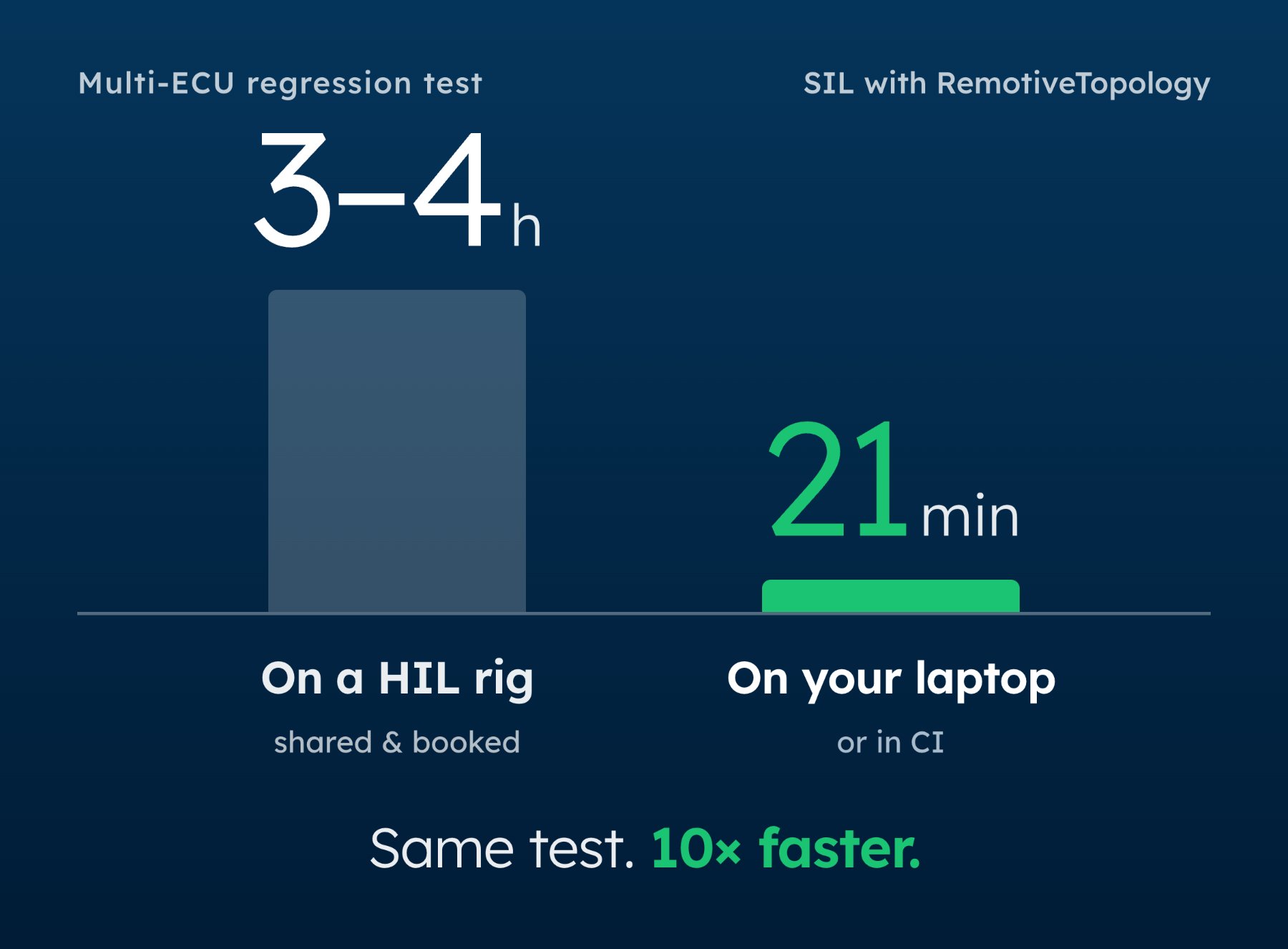
Running a test on a HIL rig involves several steps that can add up to days of waiting for results: booking the rig, flashing multiple components, and working around fragile, unstable setups and specialized tools. For the team who did this comparison, the multi-node test in HIL took on average 3-4 hours per test, and each developer currently runs such a test a few times a week (estimated at 2-3 times).

About: For a developer team with dependencies on external ECUs, the testing options were limited to: skip the test, test in the rig or in the car (if available). Mocking the endpoints in the central computer was possible but proved problematic and unstable. HIL rigs are also expensive, finite resources that aren't always available to every team.
The experience: "Previously, confirming that my application worked meant setting up a separate Windows laptop to connect to a rig, opening the bus analyzer, choosing signals and configuring monitoring manually, then hoping the setup held. Every change meant repeating that whole cumbersome process."
About: For a developer team with dependencies on external ECUs, the testing options were limited to: skip the test, test in the rig or in the car (if available). Mocking the endpoints in the central computer was possible but proved problematic and unstable. HIL rigs are also expensive, finite resources that aren't always available to every team.
The experience: "Previously, confirming that my application worked meant setting up a separate Windows laptop to connect to a rig, opening the bus analyzer, choosing signals and configuring monitoring manually, then hoping the setup held. Every change meant repeating that whole cumbersome process."
SIL: integration and regression testing virtually
Moving most regression tests to SIL complements HIL with a deterministic, faster alternative, while protecting HIL capacity for the cases that genuinely need hardware. This feature team measured a 10x improvement: from an average of 3-4 hours down to 21 minutes per test.

About: Virtualized ECU mocks and models are made available in RemotiveTopology as a reproducible, multi-node SIL environment. All network communication is generated based on the ARXML and reproduces the same signals and protocols as real hardware, so the same pattern extends to other features on the same ECUs. Tests run in Docker/Podman with automated signal observation instead of manual bus monitoring. RemotiveTopology offers a playing field with a reproducible SIL environment that acts as a single source of truth between teams.
The experience: "I have full control over the test flow from my own laptop. Stability is completely different compared to sending signals to external hardware. I subscribe to the signals specified in the ARXML and analyze them directly. I don't care about the logic inside the ECU, I care about my application sending the correct data."
The time savings with RemotiveTopology

What are the immediate benefits of integration testing with RemotiveTopology?
RemotiveTopology gives individual developers immediate benefits when running interaction tests across vehicle domains. You bring your own code, and RemotiveTopology structures it into a runnable setup, mixing and matching what you already have. You test on your own schedule, without waiting for hardware or other teams' progress.
- Faster feedback loops: regression test time cut from an average of 3-4 hours to 21 minutes, a full build, flash and test cycle, every time, with no rig booking and no fragile setup. That is 10x faster feedback, which is a crucial factor for developer experience and efficiency.
- Developer ownership: a stable, virtual setup for integration testing that puts the whole feedback loop in the developer's own hands - no booking a rig, no waiting on shared hardware. Tests run as code, on your own schedule, as often as you want and more than a physical rig allows.
- Hardware realism: signals and behaviors mirror real ECUs so teams get confidence without depending on scarce hardware and can perform integration tests earlier. RemotiveTopology's bus communication matches the production vehicle platform down to the packet encoding, IP/MAC addresses, and VLANs, so standard tools like Wireshark or candump work unmodified, and virtual and physical components can be mixed freely.
- Free up hardware: virtualization to complement HIL testing avoids bottlenecks when rigs are scarce, and simplified reuse across teams extends the benefit further. When an ECU representation is available in in the common platform, it becomes reusable and brings any test closer to real-world conditions.
How do the benefits scale across teams and time?
Saved developer time 1 month / year: As a sample calculation each developer in this team runs this type of test 2-3 times per week, lets say they save on average 1,5 hours is saved due to complementing HIL with SIL. That's 3.75 hours saved per week. Across 47 work weeks a year, it adds up to 176 hours, or 4.4 work weeks. RemotiveTopology multi-ECU SIL environment hands back roughly one month per developer, per year, redirecting waiting time to building value.
Higher software quality: Faster, more reliable feedback also compounds on its own. When a test takes minutes instead of hours, developers run it more often, regressions get caught earlier, and the whole delivery pipeline becomes more stable as a result. If your team’s deliverables depend on external signals or multi-node communication, this tool can help structure work and resources efficiently with a smoother SIL to HIL journey.
Reusable single source of truth: The biggest gain is structural - RemotiveTopology becomes a reusable single source of truth or company wide control tower that all teams can plug straight into with their own tests and tools, instead of parallel builds of similar but separated environments. "Think of integration tests as blocks. When another team creates a behavioral model of their ECU and adds it to our shared setup, we can reuse that and build a realistic chain without depending on hardware. Even if the software stack changes, the setup keeps your signals flowing, so you get stability along with speed."
Check out the latest from us
.png)
.jpg)
.jpg)

Join the automotive rebels that #getstuffdone with RemotiveLabs!